Graphs as objects associated to spectrum
Author: Ziqing Xiang
Spectral graph theory is the beautiful discipline studying network properties using the eigenvalues of associated matrices. One may wonder how far one can take this. Is a graph characterized completely by spectral information? There exist examples of non-isomorphic graphs that have the same spectrum, but there also are graphs that are determined by their spectrum. One of the big mysteries in the area is to understand which of these cases is typical.
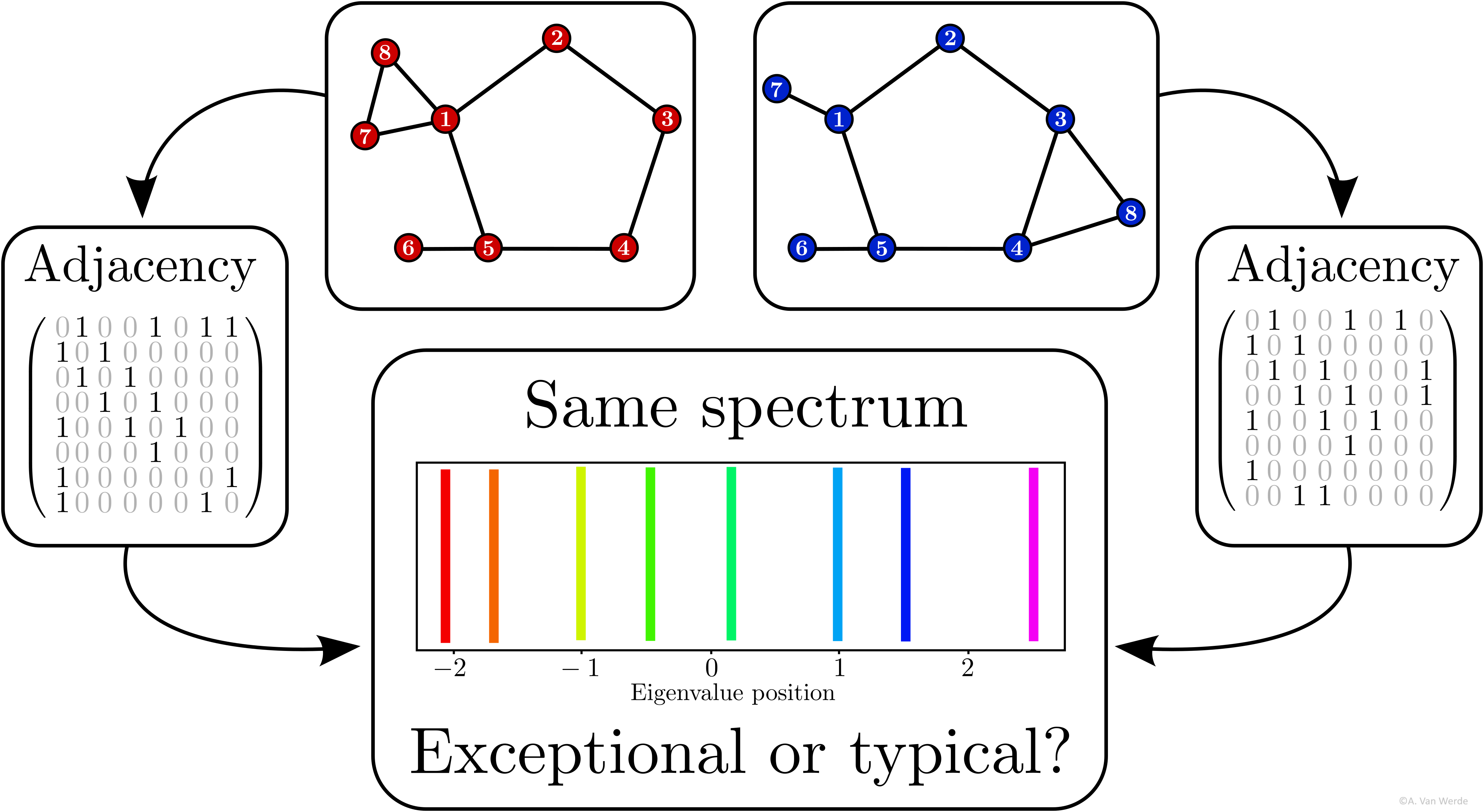
A recent development: A recent preprint (arXiv:2610.11047) asserts that it is typical for a random graph to be determined by its generalized spectrum! The generalized spectrum is the pair consisting of its adjacency spectrum of the graph and the adjacency spectrum of its complement graph. This would resolve a significant open problem in the field. Further, it would give evidence for a stronger conjecture by Van Dam and Haemers (2003) which posits that only the adjacency spectrum should suffice.
The preprint was generated almost entirely autonomously by a Large Language Model (LLM), building on previous work of various authors. For example, the arguments notably build on arithmetic sufficient conditions by Wang (2014), the idea that probabilistic theory benefits from rephrasing such conditions in terms of abstract-algebraic objects due to Lvov and Van Werde (2024, 2026), and methods to study abstract-algebraic objects associated to random matrices due to Nguyen and Wood (2022). Results by O’Rourke and Touri (2015) concerning the controllability of random graphs also play an important role.
While a lean verification of the result is forthcoming, the arguments have not yet been digested by humans. It is clear that some new ideas are involved, but their exact nature and relation to previous literature is not entirely clear. Moreover, the writing of the proofs was composed by the LLM and makes the exposition fairly intransparent.
The goal of this work group is to understand the new ideas and to produce a writeup with high-quality human exposition.
Current members of the work group:
Please feel free to contact us.
Additional members with expertise on large prime problems in combinatorial random matrix theory would be welcome.
Author: Ziqing Xiang
Author: Alexander Van Werde Before we can appreciate what ideas are new in the preprint, we need to understand the context of previous work. This is the goa...
Author: Alexander Van Werde I first heard about the question whether spectral information determines almost all graphs in a talk by Aida Abiad in 2022. She ...
Author: Alexander Van Werde I’ll start with a series of posts that discuss my initial impressions related to the LLM-generated preprint '’Almost all graphs ...